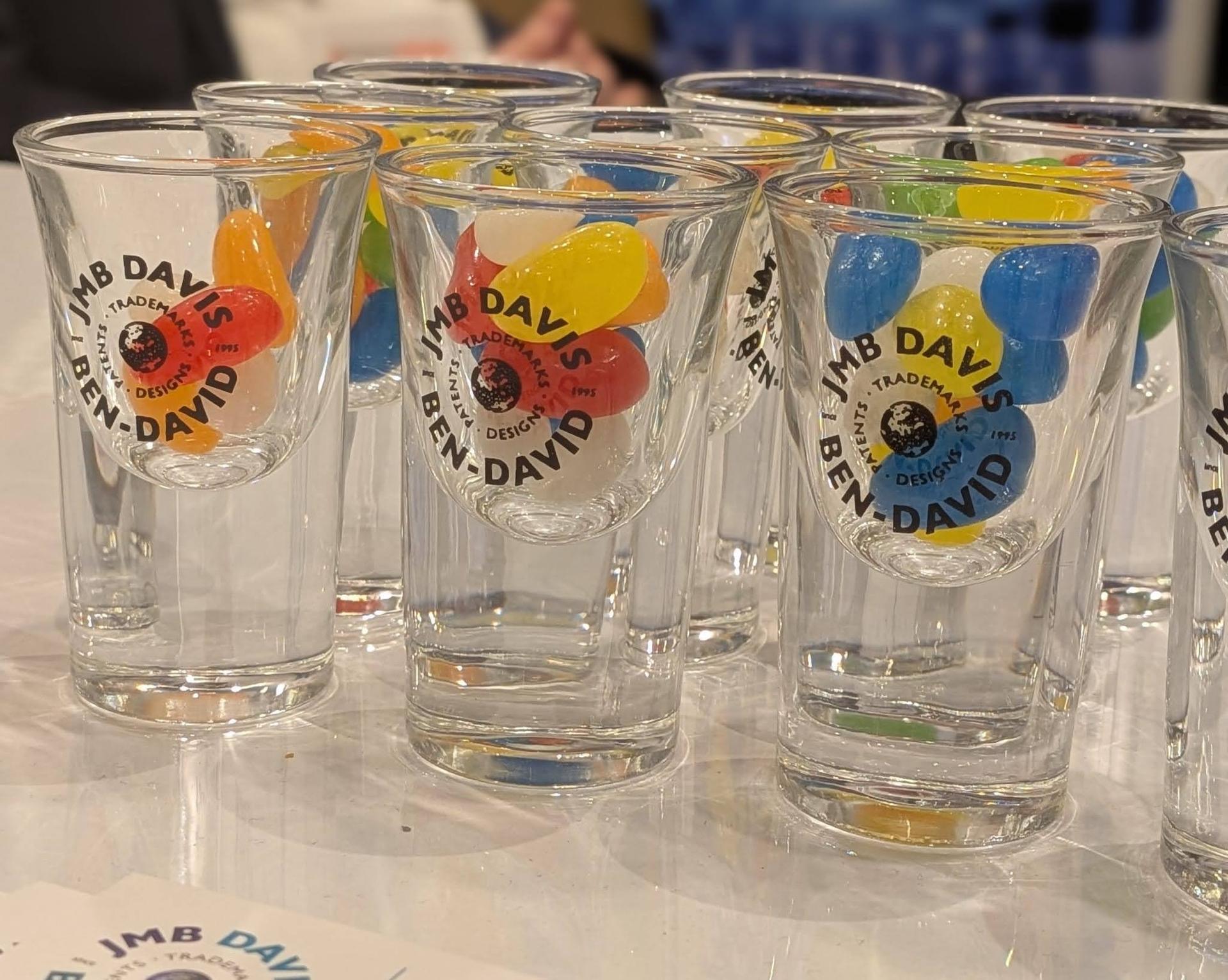
Now, remember, the conference was for biologists, chemists and all sorts of other folks connected to the sector, most of whom had at least some understanding of basic health.
Our own JMB-specific goal, of course, was to discuss patenting issues with delegates representing life science companies. However, a precursor to any conversation was a person slowing down as approaching and then passing by our booth. I presume that their eye was caught by the jellybeans. Sometimes they were so completely flummoxed by any possible relevance of jellybeans to the conference (unless we were advertising a treatment for diabetes, which we clearly were not) that they stopped altogether, and asked what we do.
It was at the awkward beginning of such encounters that I might make a semi-humorous remark about the preference of a person in choosing to either ingest the colored sugar on offer, or on declining to do so. When discussing this with one such lady visitor, “S.”, she made a comment that “there are always drugs” (to deal with the sugar). As she then rushed off, apologizing for the fact that she had to get to a lecture, I invited her to come back and to continue the conversation further, after her lecture.
I have very firm opinions about sugar, and I’m sceptical about an approach which appears to imply that we can eat whatever we want, because there are always drugs to manage the damage that we do to ourselves.
Now, you may be as surprized as I was, that S. returned to continue the conversation. Well, she did, and I reminded her that I had something to say in response to her comment about drugs. I understand that one cannot deny genetic predispositions to certain conditions. I do.
But I also feel that by paying close attention to what we eat and drink, we can avoid or at least mitigate the effects of some chronic conditions. I also know that modern medicine relies on data, and that a medical prescription of “lifestyle improvements” is tantamount to no prescription at all, as it relies solely on the habits of an individual and cannot be supervised. It’s much easier to prescribe the dosage of a specific drug and to measure the effects by conducting periodic tests.
This is more or less what I had planned to raise during my conversation with S., namely, that it’s not good enough to rely on medicines to save us from self-inflicted conditions. I was not, however, prepared for what became a sobering conversation. Without going into details in these lines, S. told me that a certain condition had developed at a fairly young age, not due to personal habits but due to external circumstances. So she was stuck with that condition, and all that could be done was to manage it – yes, possibly to mitigate its effects, but not to cure it. And that was apparently the basis for her original comment “there are always drugs” which I now understand to be an acceptance of the fact that some situations do require management, and that we are fortunate to have medicines to help us do that.
Of course, we did continue to discuss the fact that we are an IP boutique, and that we could probably help here with ongoing issues in her patent portfolio, particularly in the United States. That, of course, was the reason for our being at Biomed in the first case, and for me writing these lines(!)
So, while the sole justification for our investment of time and money in the conference was based on business considerations – which, I feel – were absolutely justified, arguably the most valuable benefit of attending – and certainly that which one could least plan for - was the opportunity to really meet people and to grow from conversations with them.
And the above conversation with S.; well, that was just one of many memorable interchanges from those three days in Tel Aviv.